Loop; Trap or Threshold
My bedroom was upstairs, small and still, the windows opening into the trees. The blur of green leaves shifted at the edge of my vision. I stood there, catching myself in the large mirror at the end of the room - caught. The reflection I met was me, yet the face of the 12 year old girl I saw was completely unrecognizable. I whispered again and again, “that’s me, that’s me,” as if naming could force recognition, but the words only deepened the strangeness. I was held in a loop of looking, naming, and disbelieving, until I felt suspended between the ceiling and the figure in the mirror. That feeling fortunately went away. The disorientation faded, but the sense that I am both inside and outside of my own body has remained. Psychology has a name for this experience, depersonalization, and it is common in adolescence.
What I experienced then could be read, in Rosalind Krauss’s terms, as a collapse of subject into image, the self consumed by its own reflection. In her essay “Video: The Aesthetics of Narcissism,” Krauss argues that early video art traps the performer in a closed circuit of self-regard, where “the body [becomes] its own surround” and the medium “defines itself in terms of the psychological condition of narcissism.” Standing in front of the monitor, the artist sees only themselves, instantly fed back, so that “the image is a mirror reflection but one which has been made technologically immediate.” In that loop, the subject cannot escape its own projection; the field of vision is sealed, self folded into self. My experience in front of the bedroom mirror was the same: each time I repeated “that’s me,” I was inside a circuit of recognition and estrangement that endlessly returned to itself, a private feedback loop without an exit. It was “only” a mirror, not a reflection translated by technological time, but at that moment I was very much stuck.
In electronic terms, feedback is the loop created when a system’s output returns to its input, producing distortion. In early video art, this became both a visual effect and a psychological metaphor, self endlessly encountering its own image. Few artists explored this more directly than Vito Acconci.
Vito Acconci’s early video performances, such as Centers (1971), Face Off (1973), and Theme Song (1973), play with the feedback. In Centers he points directly at the camera, and by extension at himself, for the duration of the tape. In Theme Song, he gazes into the lens while addressing an unseen viewer, who is ultimately himself, in a tone that blurs desire and self-absorption. As Krauss observes, these works are not about an external subject but about the artist’s own absorption within the closed circuit of camera and monitor. The subject cannot escape being both performer and audience at once.
When Krauss describes video as “narcissistic,” she seems to use the term critically, aimed as much at the culture of the 1960-70s as at artists themselves, who were often accused of being self involved at the time. Harold Rosenberg critiqued, “The artist as hero has become the artist as self-analyst.” (The De-Definition of Art, 1972, 47). Therapy culture, self-help manuals, and psychoanalytic language moved from the clinic into ordinary conversation. We do something similar now when we call someone a “narcissist,” using a clinical term as shorthand for moral judgment. For Freud, narcissism was not merely a flaw of character but a structural phase of psychic life. As Jonathan Lear observes, “narcissism is both the condition for the possibility of selfhood and the constant temptation to retreat into the self.” (Love and Its Place in Nature, 1990, 166) It is, at once, the seed of identity and its potential pathology. Krauss’s artists, Acconci, Benglis, Nauman, have bodies trapped within their own image, yet that very trap signals a historical shift, the birth of the technological self.
Legacy Russell, fluent in the acronyms of technological selfhood, calls their “real” life AFK—away from the keyboard. They flip the moral weight that clings to narcissism, arguing that for the artist to watch themselves is not a failure or a symptom of isolation. This act of self-regard becomes a performance that the digital system may misread or fail to categorize; that misreading, is what Russell calls the “glitch.” “Glitch feminism demands an occupation of the digital as a means of world-building. It allows us to seize the opportunity to generate new ideas and resources for the ongoing (r)evolution” (Glitch Feminism, p. 10) A glitch, they suggest, is not a flaw but a generative interruption. In that sense, the glitch is not failure but freedom: a moment when the system’s smooth surface breaks and other selves can appear. Even outside the digital age, artists have worked through their own glitches, or because of them. Chuck Close turned the limits of his mobility into a new kind of mark-making, and Louise Bourgeois transformed her fractured relationship with her mother into monumental spiders. These artists refused smooth compliance to the dominant culture.
Legacy Russell makes an argument specific to the digital age and to the construction of gender. For them, the glitch marks the moment a system fails and a more authentic self can emerge. They understands malfunction not as weakness but as power. In this view, self-regard becomes a form of endurance rather than vanity, a way to stay visible while undermining structures that recognize only a few normative stories. What might otherwise exclude you from the larger culture instead becomes an opening for creativity. A glitch is a threshold.
A system that fails, or is made to fail, can become either a threshold or a trap. Ingmar Bergman’s Persona offers a clear example of what Krauss calls the narcissistic trap. The film begins with a breakdown of film itself: the projector stalls, frames burn, and random images flash across the screen, the cinematic version of a feedback error. The seaside setting isolates the two women, and the boundaries between the nurse and the actress gradually dissolve. Their self-regard turns into a loss of individuality. By the final shot of the solitary Alma at the bus stop, we are left to wonder whether both women exist, or if one is an invented personality.
Glitches and invented personas are alike in their refusal of fixed identity. Tarkovsky explores the invented self in Mirror, where the poet Alexei appears as a projection of the filmmaker’s own consciousness. The film moves between memory and dream, blurring the line between the remembered and the imagined self. Through Alexei, Tarkovsky shows that identity can be built from fragments of perception and time, and that invention is not deception but another form of self-knowledge. This refusal to be fixed, whether in identity or in spirit, recalls T. S. Eliot’s Burnt Norton, the first of the Four Quartets:
“At the still point of the turning world…
And do not call it fixity,
Where past and future are gathered…
Except for the point, the still point,
There would be no dance, and there is only the dance.”
Eliot’s “still point” and Tarkovsky’s images explore the same condition: stillness within motion, time held long enough for meaning to surface in its own time.
The essay film continues this meditation on time, showing that self-portraiture can remain unfinished, fragmentary, and still true. Thomas Elsaesser defines posthumous memory as a looping relation between past, present, and future rather than a linear sequence. He writes that it “implies a special relation of past to present that no longer follows the direct linearity of cause and effect, but takes the form of a loop, in which the present rediscovers a certain past, to which it attributes the power to shape aspects of the future that are now our present.” ( Elsaesser, Thomas. “The Home Movie as Essay Film: On Making Memory Posthumously.” 217)
My own practice follows this logic: the image as an ongoing act of remembering, an afterimage that keeps shifting. Like Tarkovsky, filmmakers such as Chris Marker and Alain Resnais explore how invention and memory intertwine, turning the image into a site where past and present coexist. Elsaesser’s notion of posthumous memory describes this condition, when the camera remembers what consciousness cannot. Carol Mavor takes the idea further, describing the image as a bruise—an imprint of touch and loss that colors perception itself.
My early experiences of seeing were cinematic. The adolescent dissociation that I described at the beginning of this essay felt like my life was unfolding on a screen. It created an awareness of perception as something split, a doubling of experience that felt at once subjective and observational. The camera’s ability to both participate in and observe a scene mirrored my own sensation of being both the actor and the spectator of my life. As a young woman, this doubleness was intensified by the sense of being watched. I had already internalized what Laura Mulvey describes as the “to-be-looked-at-ness” of the female subject in classical cinema. Even outside the theater, vision was organized around surveillance and desire. The awareness of the gaze—both my own and that of others—became a structuring condition of consciousness. Hitchcock’s films, which my mother taught in her university courses, ran alongside my adolescence. In Vertigo, the act of looking is inseparable from the compulsion to recreate and control the image of a woman. The spiral motif in the film visualizes the loop of obsession.
Truffaut’s The 400 Blows offered another lesson in how time and subjectivity can be suspended. The final freeze-frame of Antoine Doinel at the edge of the sea had me checking out the VHS from the library again and again. I felt a connection to the look that refuses closure. Is the boy, finally at the end of his journey to the ocean, happy, disappointed, lost, or found? Deleuze would call this a “crystal-image,” where time folds back on itself and the past and present coexist within the same visual field. The freeze-frame functions like painting: it condenses duration into a single surface.
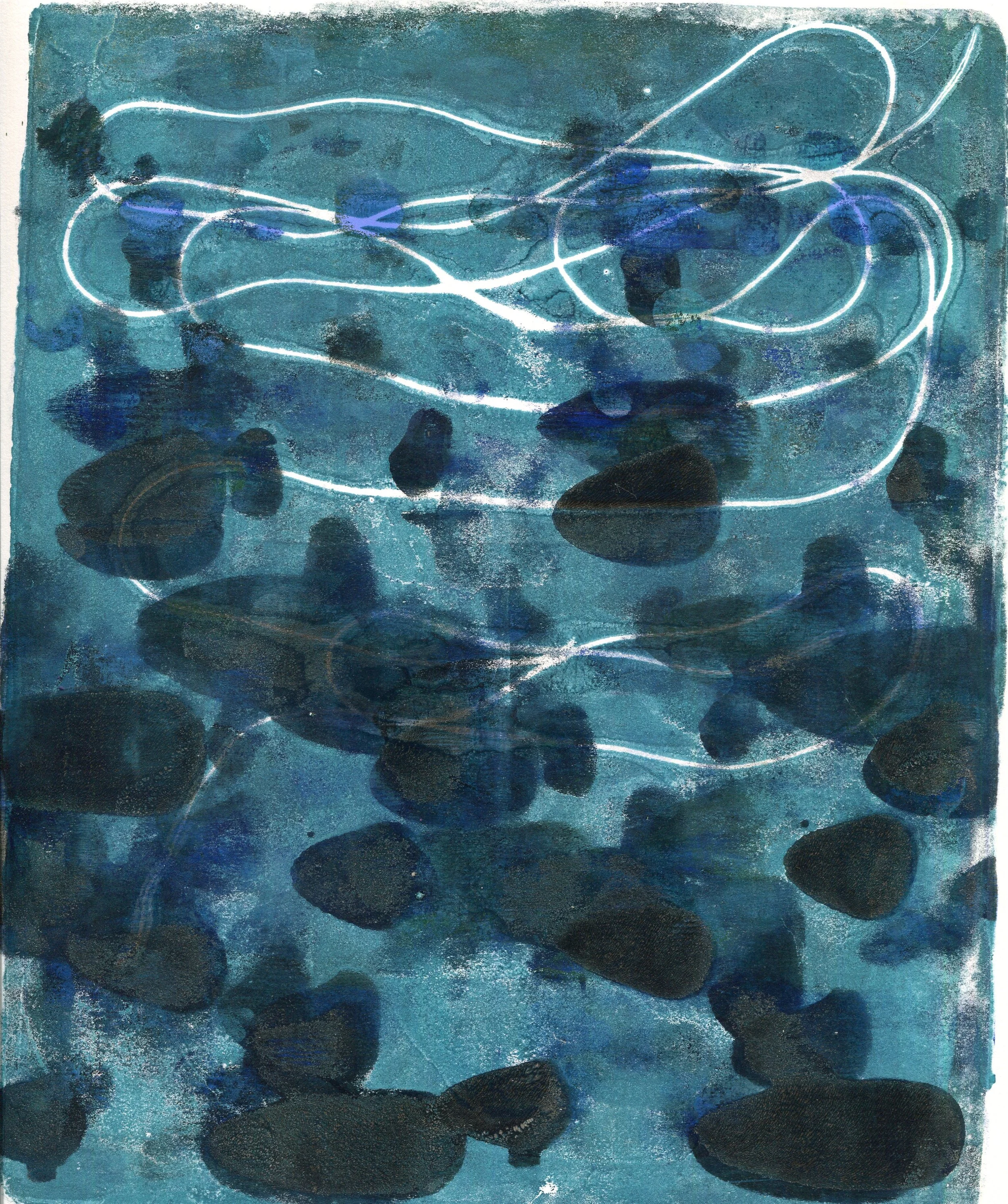
When I paint outdoors, I am aware of that same tension between movement and stillness. The tide, the wind, and the shifting light become temporal events embedded within the surface. The act of painting outdoors is not an attempt to record a fixed scene but to remain present to transformation. Plein-air practice demands attentiveness to duration; it makes visible the interval between seeing and marking. Each brushstroke responds to change— the arrival of a cloud, the shift of color across the water’s surface—so that time itself becomes the medium.
In the studio, this immediacy turns reflective. The field drawings and notations I bring back from the marsh are fragments of perception. Layers of paint accumulate through a process closer to editing than depiction. I reframe what was seen and remembered. The work becomes a dialogue between memory and speculative place, between the lived moment and its afterimage. Through this oscillation, the painting begins to operate as a temporal construction rather than a static representation.
In this sense, my practice inherits cinema’s temporal and psychological structures. The surface becomes an editing field where fragments of perception, recollection, and projection intersect. The painting does not resolve experience into narrative. Ultimately, both film and painting offer ways to hold time open. They allow perception to linger and delay resolution. In plein-air work, this openness is enacted through the body’s direct negotiation with light and weather; in the studio, it becomes a meditative reconstruction of experience. The resulting image, like a cinematic frame, exists not as an end point but as a layered interval in which time and perception are suspended.
Bergman, Ingmar, director. Persona. Svensk Filmindustri, 1966.
Eliot, T. S. Four Quartets. Harcourt, 1943.
Elsaesser, Thomas. “The Home Movie as Essay Film: On Making Memory Posthumously.” Beyond the Essay Film: Subjectivity, Textuality and Technology, edited by Julia Vassilieva and Deane Williams, Amsterdam University Press, 2020, pp. 213–233.
Krauss, Rosalind E. “Video: The Aesthetics of Narcissism.” October, no. 1, Spring 1976, pp. 50–64.
Lear, Jonathan. Love and Its Place in Nature: A Philosophical Interpretation of Freudian Psychoanalysis. Farrar, Straus and Giroux, 1990.
Rosenberg, Harold. The De-Definition of Art: Action Art to Pop to Earthworks. University of Chicago Press, 1972.
Russell, Legacy. Glitch Feminism: A Manifesto. Verso, 2020.
Tarkovsky, Andrei, director. Mirror. Mosfilm, 1975.